Calculating variance is a crucial step in understanding the spread of data in statistics. It measures how much individual data points deviate from the mean value of the dataset. In this article, we will explore the steps to calculate variance, providing a comprehensive guide for those looking to grasp this fundamental concept in data analysis.
1. Gather Your Data
To start, you need to collect all the data points you want to analyze. This could be exam scores, stock prices, or any other set of numbers you're interested in. Ensure that your data is accurate and free from errors, as incorrect data can lead to misleading results.
2. Calculate the Mean
The mean, or average, of your dataset is the first value you need to calculate. To find the mean, add up all your data points and then divide by the total number of points. The formula for the mean is (Σx)/N, where Σx is the sum of all data points and N is the number of data points.
3. Subtract the Mean from Each Data Point
For each data point, subtract the mean value calculated in the previous step. This will give you the deviation of each point from the mean. The formula for this is x - μ, where x is the individual data point and μ is the mean.
4. Square Each Deviation
Take each deviation from the mean (calculated in step 3) and square it. This step is crucial because it ensures that all values are positive and gives more weight to larger deviations. The formula here is (x - μ)^2.
5. Calculate the Sum of Squared Deviations
Add up all the squared deviations calculated in the previous step. This sum represents the total amount of variation in your dataset. The formula for the sum of squared deviations is Σ(x - μ)^2.
6. Divide by the Number of Data Points
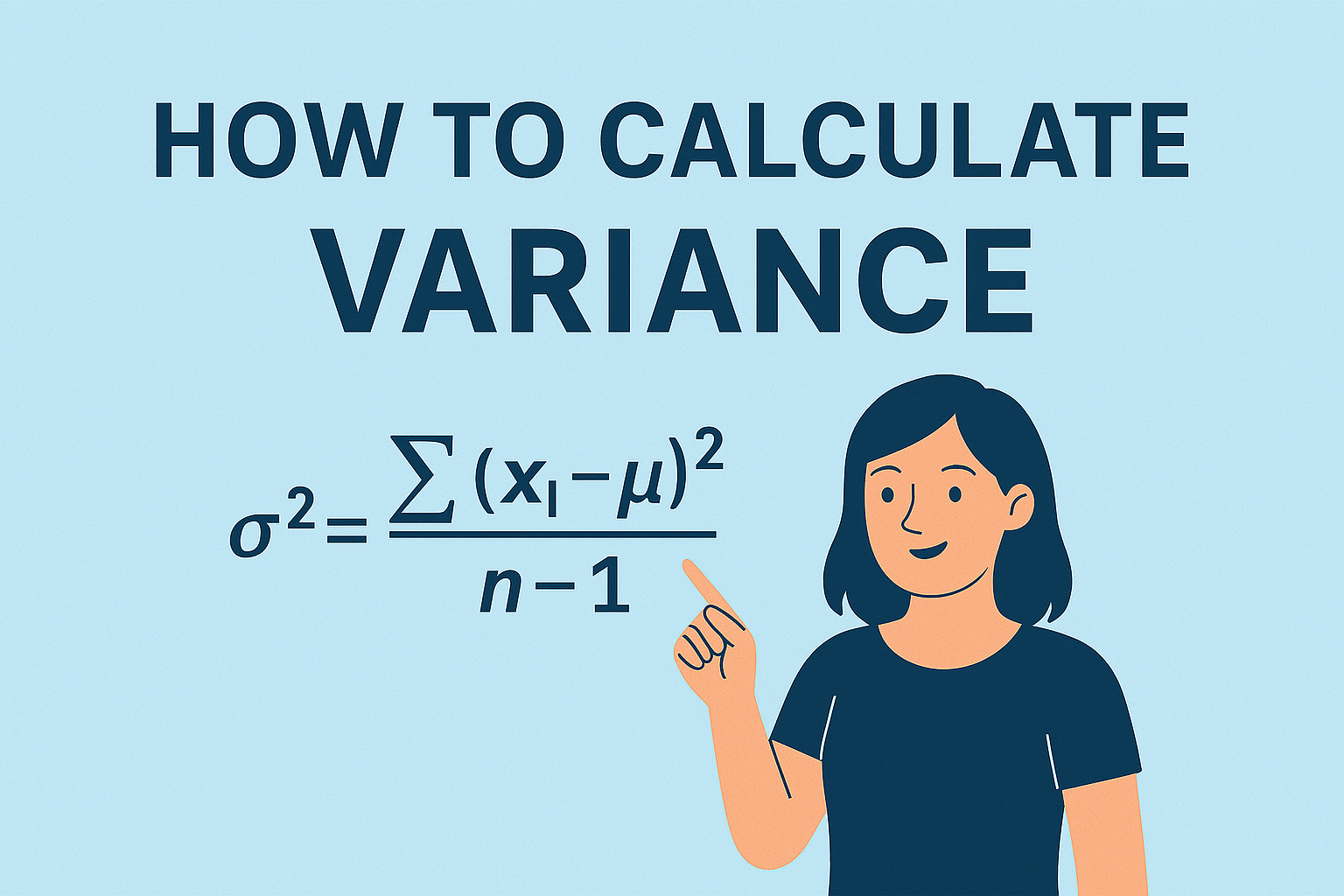
To find the variance, divide the sum of squared deviations by the number of data points. However, for sample variance (which is commonly used), you divide by N-1, where N is the number of data points. The formula for population variance is Σ(x - μ)^2/N, and for sample variance, it's Σ(x - μ)^2/(N-1).
7. Choose Between Population and Sample Variance
Determine whether you are calculating the variance for a population or a sample. If you have data for every member of the group you're interested in, use the population variance formula. If your data is a subset of the group, use the sample variance formula.
8. Interpret Your Variance
Once you have calculated the variance, consider what it means. A high variance indicates that the data points are spread out over a large range of values, while a low variance means the data points tend to be close to the mean value. This interpretation is crucial for understanding the spread of your data.
9. Consider Using Technology for Calculation
For large datasets, calculating variance manually can be time-consuming and prone to error. Consider using a calculator, spreadsheet software like Excel, or programming languages like Python, which have built-in functions to calculate variance efficiently and accurately.
10. Apply Variance to Real-World Problems
Variance has numerous applications in real-world problems, including finance, engineering, and social sciences. By understanding and calculating variance, you can make more informed decisions based on the spread of data, such as assessing risk in investments or quality control in manufacturing.
If you are searching about 3 Easy Ways to Calculate Variance - wikiHow you've visit to the right web. We have 10 Pics about 3 Easy Ways to Calculate Variance - wikiHow like How to Calculate Variance (Step-by-Step) - OneSDR - 🛜 Technology, 3 Easy Ways to Calculate Variance - wikiHow and also 3 Ways to Calculate Variance - wikiHow. Here you go:
3 Easy Ways To Calculate Variance - WikiHow
 www.wikihow.com
3 Easy Ways to Calculate Variance - wikiHow
3 Ways To Calculate Variance - WikiHow
 www.wikihow.com
3 Ways to Calculate Variance - wikiHow
3 Ways To Calculate Variance - WikiHow
 www.wikihow.com
3 Ways to Calculate Variance - wikiHow
3 Easy Ways To Calculate Variance - WikiHow
 www.wikihow.com
3 Easy Ways to Calculate Variance - wikiHow
3 Easy Ways To Calculate Variance - WikiHow
 www.wikihow.com
3 Easy Ways to Calculate Variance - wikiHow
3 Ways To Calculate Variance - WikiHow
 www.wikihow.com
3 Ways to Calculate Variance - wikiHow
3 Ways To Calculate Variance - WikiHow
 www.wikihow.com
3 Ways to Calculate Variance - wikiHow
How To Calculate Variance (Step-by-Step) - OneSDR - 🛜 Technology
 www.onesdr.com
How to Calculate Variance (Step-by-Step) - OneSDR - 🛜 Technology
3 Easy Ways To Calculate Variance - WikiHow
 www.wikihow.com
3 Easy Ways to Calculate Variance - wikiHow
3 Ways To Calculate Variance - WikiHow
 www.wikihow.com
3 Ways to Calculate Variance - wikiHow
3 easy ways to calculate variance. 3 ways to calculate variance. 3 ways to calculate variance

