When working with microscopes, calculating the total magnification is crucial to understanding the scale of the objects you're observing. Whether you're a student, researcher, or hobbyist, knowing how to calculate total magnification can help you make the most of your microscope and achieve accurate results. In this article, we'll break down the steps to calculate total magnification, making it easier for you to get started with your microscopic explorations.
1. Understand the Basics of Magnification
Magnification is the process of enlarging an object or image, making it appear larger than its actual size. In microscopy, magnification is achieved through the use of lenses, which bend light to produce a magnified image. To calculate total magnification, you need to understand the individual magnifications of the objective lens, ocular lens, and any additional optical components.
2. Identify the Objective Lens Magnification
The objective lens is the primary lens that collects light from the sample and produces the initial magnified image. Common objective lens magnifications include 4x, 10x, 20x, 40x, and 100x. You can usually find the magnification power of the objective lens printed on the lens itself or in the microscope's documentation.
3. Determine the Ocular Lens Magnification
The ocular lens, also known as the eyepiece, further magnifies the image produced by the objective lens. Standard ocular lens magnifications include 10x, 15x, and 20x. Like the objective lens, the magnification power of the ocular lens is usually indicated on the lens or in the microscope's documentation.
4. Calculate the Total Magnification
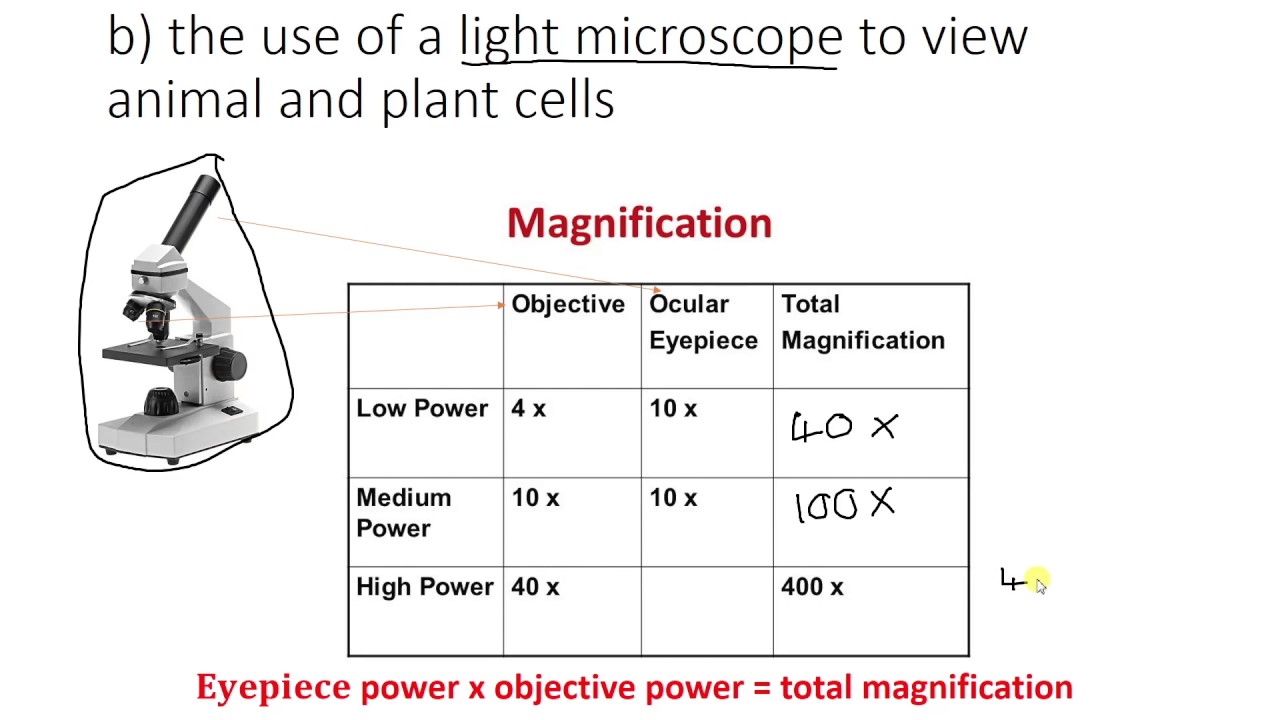
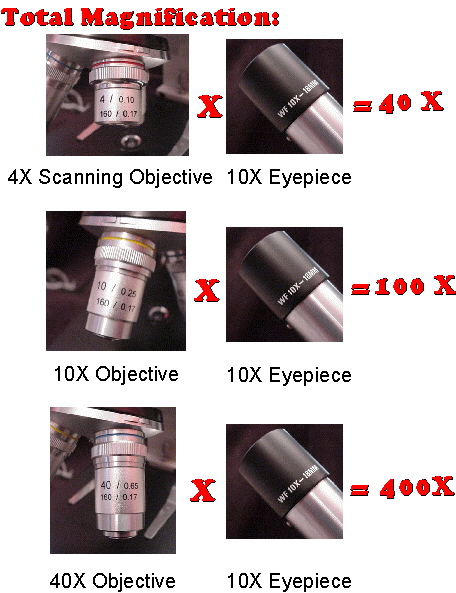
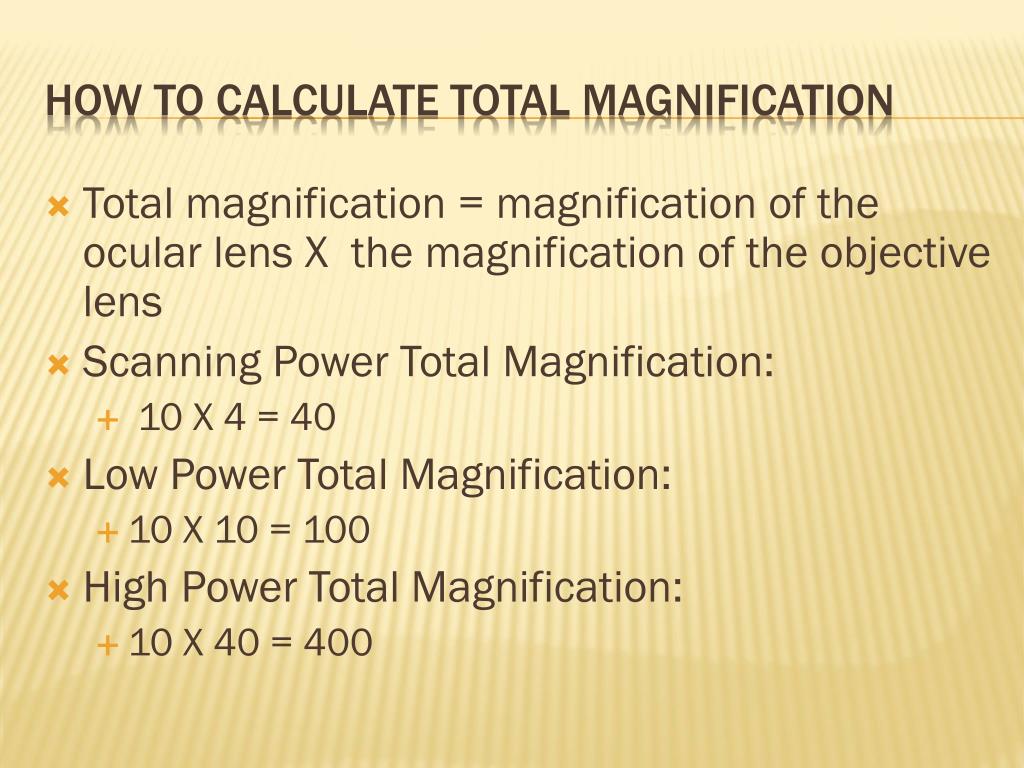
To calculate the total magnification, you multiply the magnification power of the objective lens by the magnification power of the ocular lens. For example, if you're using a 40x objective lens with a 10x ocular lens, the total magnification would be 40x * 10x = 400x.
5. Consider Additional Optical Components
In some microscopes, additional optical components like zoom lenses, auxiliary lenses, or digital adapters may be used to further modify the magnification. These components can either increase or decrease the total magnification, depending on their specific design and application.
6. Check for Magnification Labels on the Microscope
Many microscopes have magnification labels or markings on the stage, nosepiece, or other components. These labels can provide a quick reference to the total magnification, but it's still important to understand how to calculate it manually to ensure accuracy.
7. Use a Magnification Calculator or Chart
If you're having trouble calculating the total magnification manually, you can use a magnification calculator or chart to simplify the process. These tools can be found online or in microscope manuals and can help you quickly determine the total magnification based on the objective and ocular lens combinations.
8. Practice and Verify Your Calculations
As with any scientific technique, practice makes perfect when it comes to calculating total magnification. Verify your calculations by checking the microscope's documentation, consulting with colleagues or experts, or using calibration slides to ensure accuracy.
9. Consider Digital Magnification
In digital microscopy, the total magnification may also include the digital zoom or magnification applied by the camera or software. This digital magnification can significantly increase the overall magnification power, but it's essential to understand the limitations and potential distortions introduced by digital magnification.
10. Review and Refine Your Understanding
Calculating total magnification is an essential skill for anyone working with microscopes. By reviewing and refining your understanding of the process, you'll become more confident in your abilities and better equipped to achieve accurate and reliable results in your microscopic explorations.
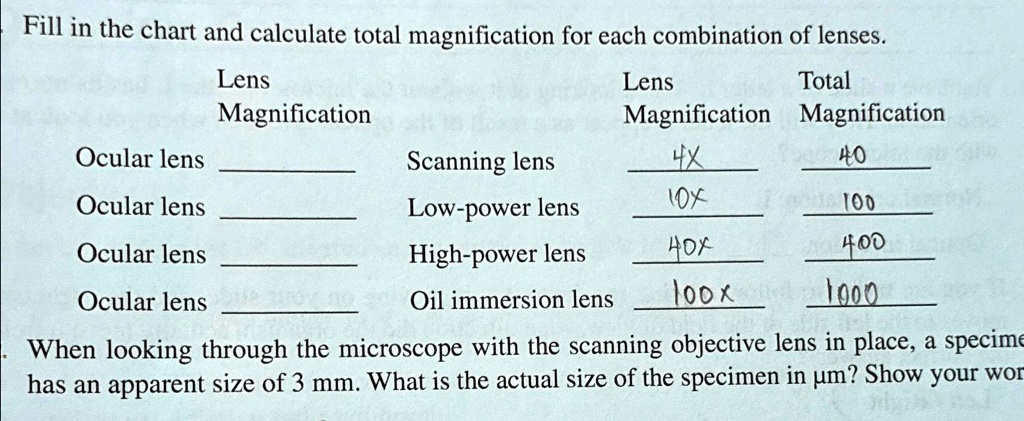
If you are searching about fill in the chart and calculate total magnification for each you've came to the right page. We have 10 Pictures about fill in the chart and calculate total magnification for each like PPT - Microscopes and Cells PowerPoint Presentation - ID:3213515, Objective Lens In Total Magnification at Jewel Jones blog and also MICROSCOPE. - ppt download. Here it is:
Fill In The Chart And Calculate Total Magnification For Each
 www.numerade.com
fill in the chart and calculate total magnification for each ...
B2.2 Inside Bacteria
 www.slideshare.net
B2.2 Inside Bacteria
PPT - Microscopes And Cells PowerPoint Presentation - ID:3213515
 www.slideserve.com
PPT - Microscopes and Cells PowerPoint Presentation - ID:3213515
Objective Lens In Total Magnification At Jewel Jones Blog
 storage.googleapis.com
Objective Lens In Total Magnification at Jewel Jones blog
Lowmagnification Images Of Particles Sampled Directly
 fity.club
Lowmagnification Images Of Particles Sampled Directly
Magnification
 cas.miamioh.edu
Magnification
Compound Light Microscope Magnification Calculation | Shelly Lighting
 shellysavonlea.net
Compound Light Microscope Magnification Calculation | Shelly Lighting
PPT - Microscopes PowerPoint Presentation, Free Download - ID:2684520
 www.slideserve.com
PPT - Microscopes PowerPoint Presentation, free download - ID:2684520
Compound Light Microscope Magnification Calculation | Shelly Lighting
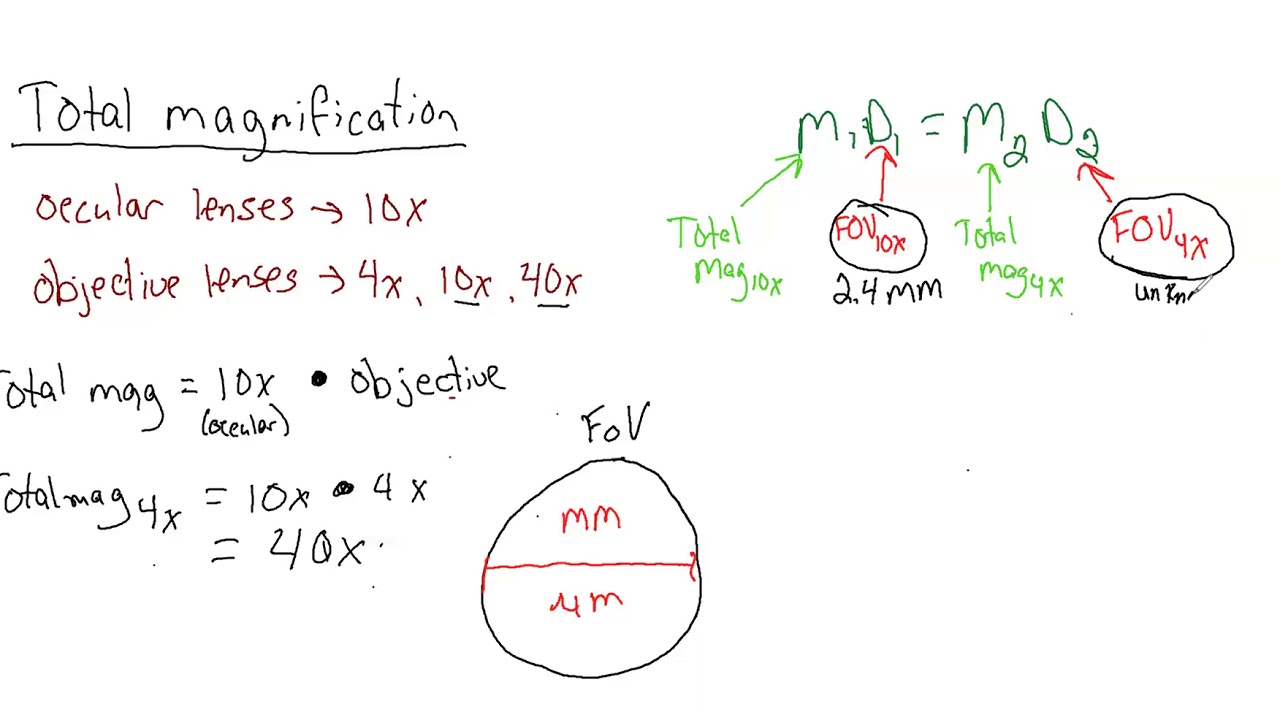 shellysavonlea.net
Compound Light Microscope Magnification Calculation | Shelly Lighting
MICROSCOPE. - Ppt Download
 slideplayer.com
MICROSCOPE. - ppt download
Compound light microscope magnification calculation. Compound light microscope magnification calculation. Fill in the chart and calculate total magnification for each ...

