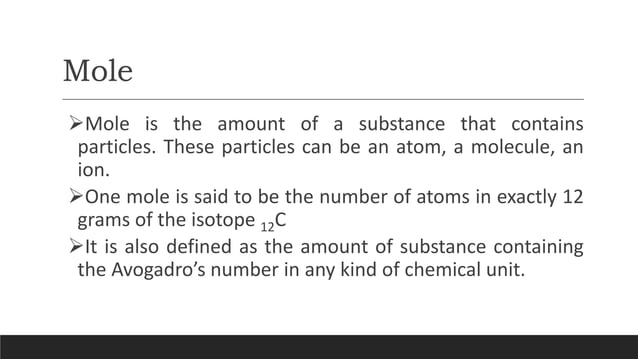
Moles are a fundamental unit of measurement in chemistry, and their calculation is crucial in various chemical reactions and processes. The mole is defined as the amount of substance that contains as many particles (atoms, molecules, or ions) as there are atoms in 0.012 kilograms of carbon-12. In this article, we will discuss the different ways moles are calculated in professional settings.
1. Molar Mass Calculation
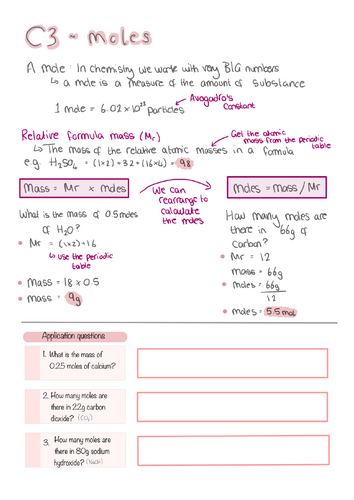
The molar mass of a substance is calculated by summing the atomic masses of its constituent atoms. This value is then used to calculate the number of moles of the substance. For example, the molar mass of water (H2O) is approximately 18 grams per mole, which means that one mole of water weighs 18 grams.
2. Avogadro's Number
Avogadro's number (6.022 x 10^23) is a constant that represents the number of particles in one mole of a substance. This number is used to calculate the number of moles of a substance by dividing the total number of particles by Avogadro's number. For instance, if you have 1.2 x 10^25 particles of a substance, you can calculate the number of moles by dividing this value by Avogadro's number.
3. Mass-Mole Conversion
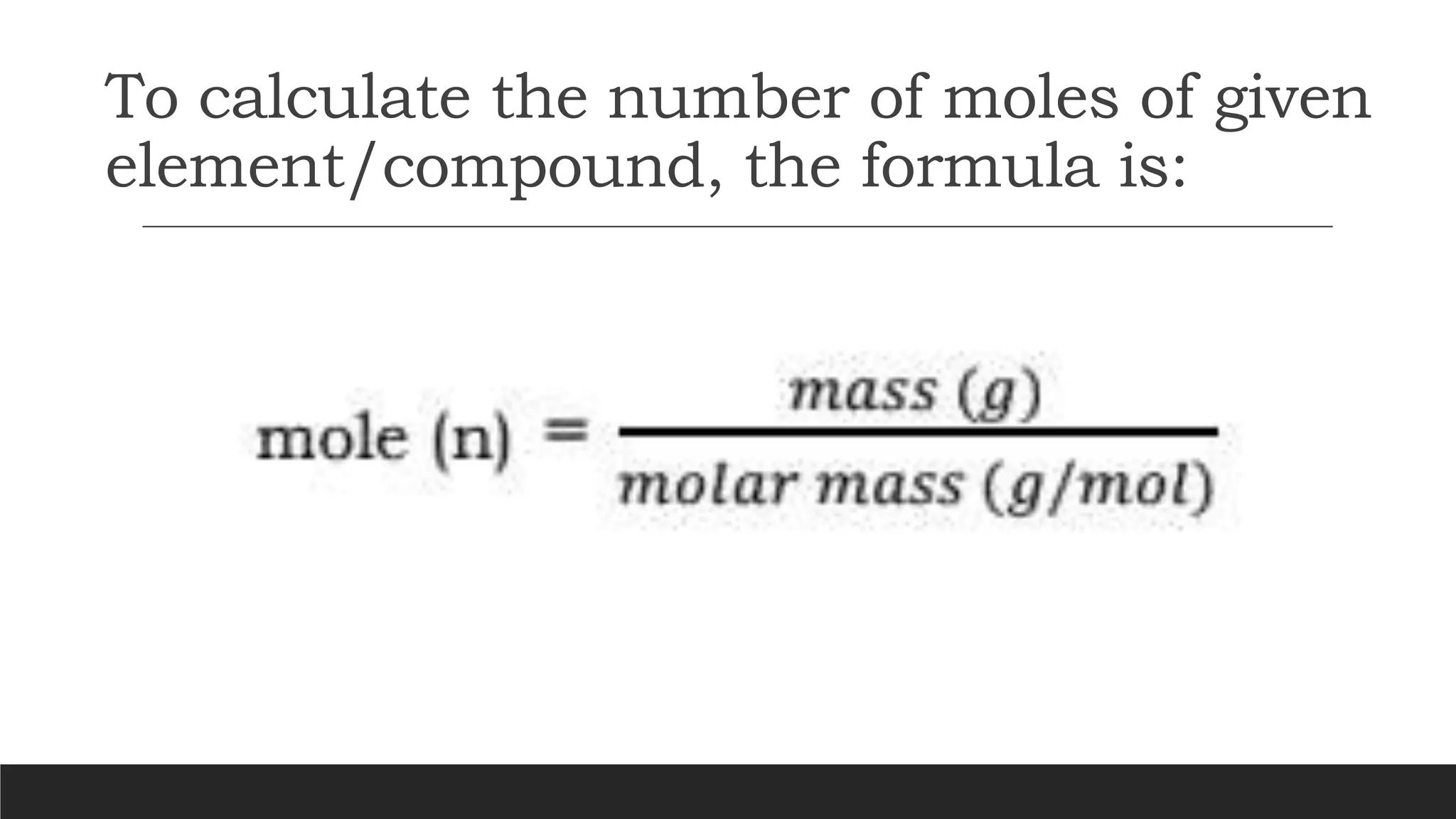
The mass-mole conversion is a common method used to calculate the number of moles of a substance. This involves dividing the mass of the substance (in grams) by its molar mass. For example, if you have 45 grams of sodium chloride (NaCl), you can calculate the number of moles by dividing 45 by the molar mass of NaCl (58.44 grams per mole).
4. Mole-Mole Conversion
In chemical reactions, the mole-mole conversion is used to calculate the number of moles of a product or reactant. This involves using the stoichiometric coefficients of the balanced chemical equation to relate the number of moles of one substance to another. For instance, in the reaction 2H2 + O2 -> 2H2O, two moles of hydrogen gas produce two moles of water.
5. Gas Law Calculations
The ideal gas law (PV = nRT) is used to calculate the number of moles of a gas. By rearranging the equation to solve for n (number of moles), you can calculate the number of moles of a gas using its pressure, volume, and temperature. For example, if you have a gas with a pressure of 1 atm, a volume of 10 liters, and a temperature of 273 K, you can calculate the number of moles using the ideal gas law.
6. Solution Concentration Calculations
In solution chemistry, the concentration of a solute is often expressed in terms of moles per liter (molarity). To calculate the number of moles of a solute, you can multiply the molarity of the solution by its volume in liters. For instance, if you have a 2 M solution of sodium chloride with a volume of 0.5 liters, you can calculate the number of moles of NaCl by multiplying the molarity by the volume.
7. Empirical Formula Calculation
The empirical formula of a compound is the simplest whole-number ratio of atoms of each element in the compound. To calculate the empirical formula, you need to calculate the number of moles of each element in the compound. This involves dividing the mass of each element by its atomic mass and then simplifying the resulting ratios to whole numbers.
8. Percentage Composition Calculation
The percentage composition of a compound is the percentage by mass of each element in the compound. To calculate the percentage composition, you need to calculate the number of moles of each element in the compound and then multiply by its molar mass. For example, if you have a compound with a molecular formula of C2H6O, you can calculate the percentage composition of each element by calculating the number of moles of each element and then multiplying by its atomic mass.
9. Limiting Reactant Calculations
In chemical reactions, the limiting reactant is the reactant that is completely consumed first, limiting the amount of product that can be formed. To determine the limiting reactant, you need to calculate the number of moles of each reactant and then compare these values to the stoichiometric coefficients of the balanced chemical equation.
10. Yield Calculations
The yield of a chemical reaction is the amount of product actually obtained compared to the theoretical yield. To calculate the yield, you need to calculate the number of moles of the product actually obtained and then compare this value to the theoretical yield, which is calculated using the stoichiometric coefficients of the balanced chemical equation.
If you are looking for Calculating Moles.pptx you've came to the right web. We have 10 Pics about Calculating Moles.pptx like MOLES CALCULATIONS | Teaching Resources, Calculating Moles | Teaching Resources and also Calculating - With - Moles - IGCSE | PDF | Chemical Reactions | Mole (Unit). Read more:
Calculating Moles.pptx
 www.slideshare.net
Calculating Moles.pptx
Calculating Moles.pptx
 www.slideshare.net
Calculating Moles.pptx
Calculating Moles.pptx
 www.slideshare.net
Calculating Moles.pptx
Calculating Moles.pptx
 www.slideshare.net
www.slideshare.net
Calculating Moles.pptx
Moles + Chemical Calculations | PDF | Mole (Unit) | Chemical Compounds
 www.scribd.com
Moles + Chemical Calculations | PDF | Mole (Unit) | Chemical Compounds
Calculating - With - Moles - IGCSE | PDF | Chemical Reactions | Mole (Unit)
 www.scribd.com
Calculating - With - Moles - IGCSE | PDF | Chemical Reactions | Mole (Unit)
Calculating Moles | Teaching Resources
 www.tes.com
Calculating Moles | Teaching Resources
Calculating Moles.pptx
 www.slideshare.net
Calculating Moles.pptx
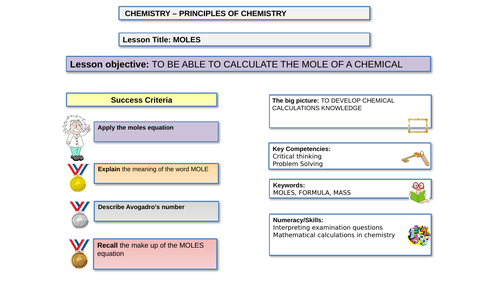
MOLES CALCULATIONS | Teaching Resources
 www.tes.com
MOLES CALCULATIONS | Teaching Resources
Calculating Moles | Teaching Resources
 www.tes.com
Calculating Moles | Teaching Resources
Calculating moles. Calculating moles.pptx. moles + chemical calculations

