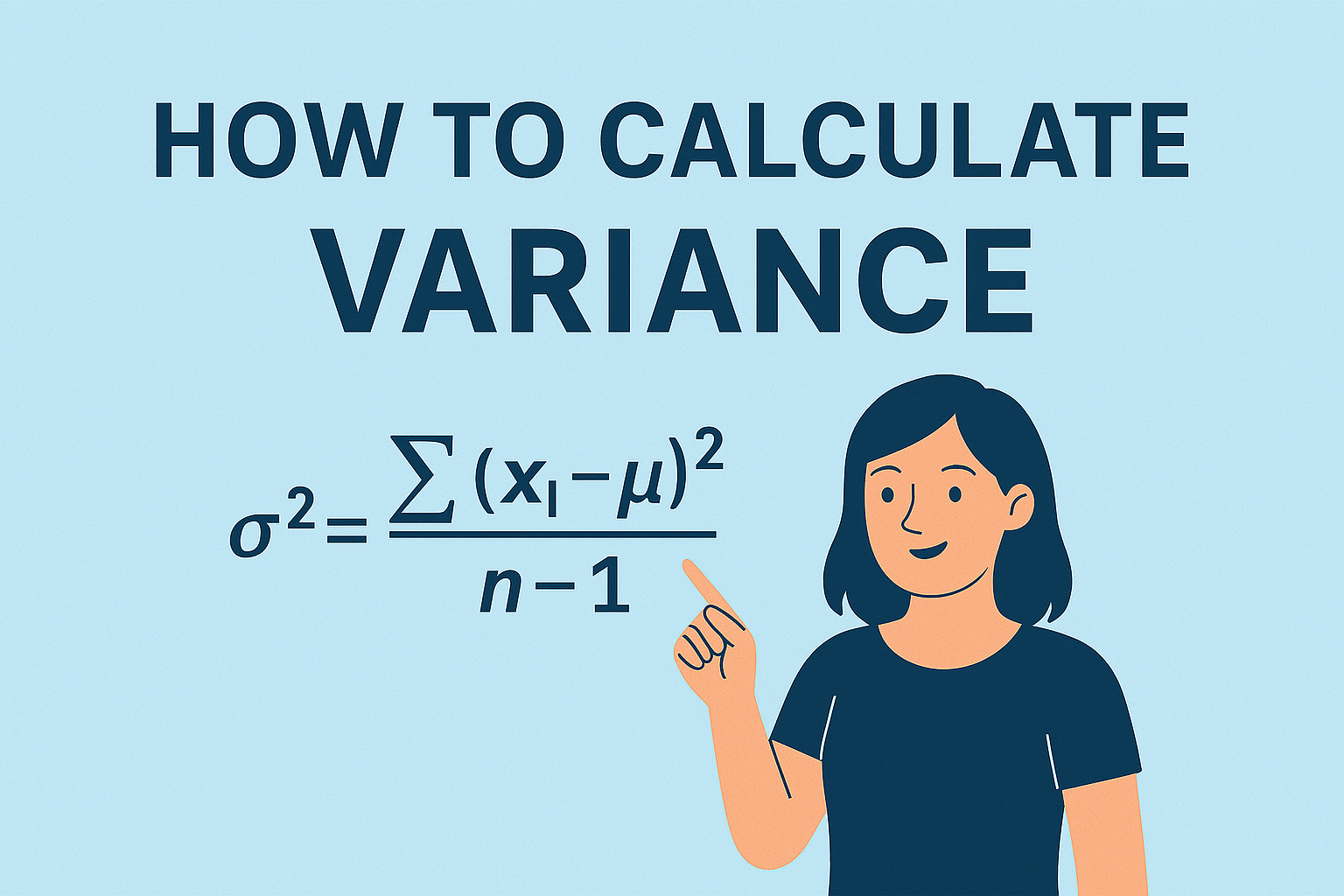
Calculating variance is a crucial step in understanding and analyzing data, as it helps to measure the spread or dispersion of a set of values from their mean. In simple terms, variance tells you how much individual data points deviate from the average value of the dataset. A low variance indicates that the data points are close to the mean, while a high variance suggests that they are spread out. Here's a step-by-step guide on how to calculate variance in a dataset.
1. Gather Your Data
The first step in calculating variance is to gather your data. This could be a set of numbers representing anything from exam scores to stock prices. Ensure that your data is clean and free of any outliers or anomalies that could skew your results. For example, if you're calculating the variance of exam scores, make sure you have the complete set of scores for the class.
2. Calculate the Mean
Before you can calculate the variance, you need to find the mean of your dataset. The mean, or average, is calculated by adding up all the numbers in your dataset and then dividing by the total number of values. For instance, if your dataset is 1, 2, 3, 4, 5, the mean would be (1+2+3+4+5)/5 = 3.
3. Subtract the Mean from Each Value
Once you have the mean, subtract it from each value in your dataset. This step is crucial because it gives you the deviation of each data point from the mean. Using the dataset 1, 2, 3, 4, 5 with a mean of 3, you would get -2, -1, 0, 1, 2 after subtracting the mean from each value.
4. Square Each Result
Next, you square each result from the previous step. This is done to ensure that all values are positive and to weight them by magnitude. Using the results from the previous step -2, -1, 0, 1, 2, you would square each to get 4, 1, 0, 1, 4.
5. Calculate the Average of the Squared Results
To find the variance, you calculate the average of the squared results. This is done by adding up all the squared results and then dividing by the number of items in your dataset. For the squared results 4, 1, 0, 1, 4, the sum is 10, and dividing by the number of items (5) gives a variance of 2.
6. Consider the Type of Variance
There are two types of variance: population variance and sample variance. If you're working with the entire population, you use the formula for population variance. However, if you're working with a sample of the population, you should use the formula for sample variance, which divides by (n-1) instead of n to get an unbiased estimator of the population variance.
7. Apply the Formula for Sample Variance if Necessary
If you're dealing with a sample of the population, you'll use the sample variance formula. This formula is similar to the population variance formula, except you divide by (n-1) instead of n. For example, if you have a sample of exam scores and you want to estimate the variance of the entire class, you would use the sample variance formula.
8. Interpret Your Results
After calculating the variance, it's essential to interpret your results. A high variance means that the data points are spread out over a large range of values, while a low variance means they are closely clustered around the mean. This interpretation can significantly impact your analysis, especially when comparing different datasets or making predictions based on historical data.
9. Use Variance in Further Analysis
Variance is a fundamental component in many statistical analyses and calculations, such as standard deviation, coefficient of variation, and covariance. It's also crucial in regression analysis and hypothesis testing. Understanding and calculating variance is, therefore, a key skill for anyone working with data.
10. Consider Advanced Topics
For more complex datasets or specific types of data, you might need to consider advanced topics such as conditional variance, variance in time series analysis, or how to handle variance in multivariate datasets. These topics are crucial in fields like finance, engineering, and scientific research, where understanding variability is key to making accurate predictions and models.
If you are searching about 3 Ways to Calculate Variance - wikiHow you've visit to the right web. We have 10 Pictures about 3 Ways to Calculate Variance - wikiHow like How to Calculate Variance (Step-by-Step) - OneSDR - 🛜 Technology, 3 Easy Ways to Calculate Variance - wikiHow and also 3 Ways to Calculate Variance - wikiHow. Here it is:
3 Ways To Calculate Variance - WikiHow
 www.wikihow.com
3 Ways to Calculate Variance - wikiHow
3 Ways To Calculate Variance - WikiHow
 www.wikihow.com
3 Ways to Calculate Variance - wikiHow
3 Easy Ways To Calculate Variance - WikiHow
 www.wikihow.com
3 Easy Ways to Calculate Variance - wikiHow
3 Ways To Calculate Variance - WikiHow
 www.wikihow.com
3 Ways to Calculate Variance - wikiHow
3 Easy Ways To Calculate Variance - WikiHow
 www.wikihow.com
3 Easy Ways to Calculate Variance - wikiHow
3 Ways To Calculate Variance - WikiHow
 www.wikihow.com
3 Ways to Calculate Variance - wikiHow
3 Easy Ways To Calculate Variance - WikiHow
 www.wikihow.com
3 Easy Ways to Calculate Variance - wikiHow
3 Easy Ways To Calculate Variance - WikiHow
 www.wikihow.com
3 Easy Ways to Calculate Variance - wikiHow
How To Calculate Variance (Step-by-Step) - OneSDR - 🛜 Technology
 www.onesdr.com
How to Calculate Variance (Step-by-Step) - OneSDR - 🛜 Technology
3 Ways To Calculate Variance - WikiHow
 www.wikihow.com
3 Ways to Calculate Variance - wikiHow
3 ways to calculate variance. 3 easy ways to calculate variance. 3 easy ways to calculate variance

